Best Framer Ecommerce Templates in 2026
Framer's ecommerce capabilities have moved well past "it can show a product card." With Shopify integration, dynamic CMS-driven product pages, and the same animation and design freedom Framer is known for, building an online store on Framer in 2026 is a legitimate option — not just a workaround for designers who don't want to touch Shopify themes.
The catch is that the ecosystem of Framer ecommerce templates has grown fast, and most "best of" lists are either auto-generated rankings or thinly disguised affiliate dumps. This piece is different: I went through each template, looked at the live preview, and judged it on what's actually visible — design, structure, ecommerce usability, and visual quality. Where a template excels, I say so. Where it has trade-offs, I say that too.
For full transparency: two of the templates below (Menorca and Vaer) are mine. I've tried to evaluate all six on the same terms. If anything, I'm probably harder on my own.
What makes a good Framer ecommerce template?
Before the list, the criteria. A strong Framer ecommerce template tends to do most of the following well:
Clear product presentation. Product cards that are scannable, product detail pages that don't fight the buyer, and imagery that has room to breathe.
Strong visual direction. A point of view. The template should feel like something, not like the default of nothing.
Flexible structure. Sections, components, and pages that can be reused, swapped, or removed without breaking the layout.
Mobile-first responsiveness. Most ecommerce traffic is mobile. A template that only looks good at 1440px is a liability.
Conversion-focused layout. Clear CTAs, visible pricing, trust signals, and a logical path from landing to product.
Brand perception. The template should make the brand look intentional, not generic.
Ease of customization. Predictable component structure and clean overrides matter more than people think — especially if you're handing the project off to a client.
With that in mind, here are the six.
1. Menorca
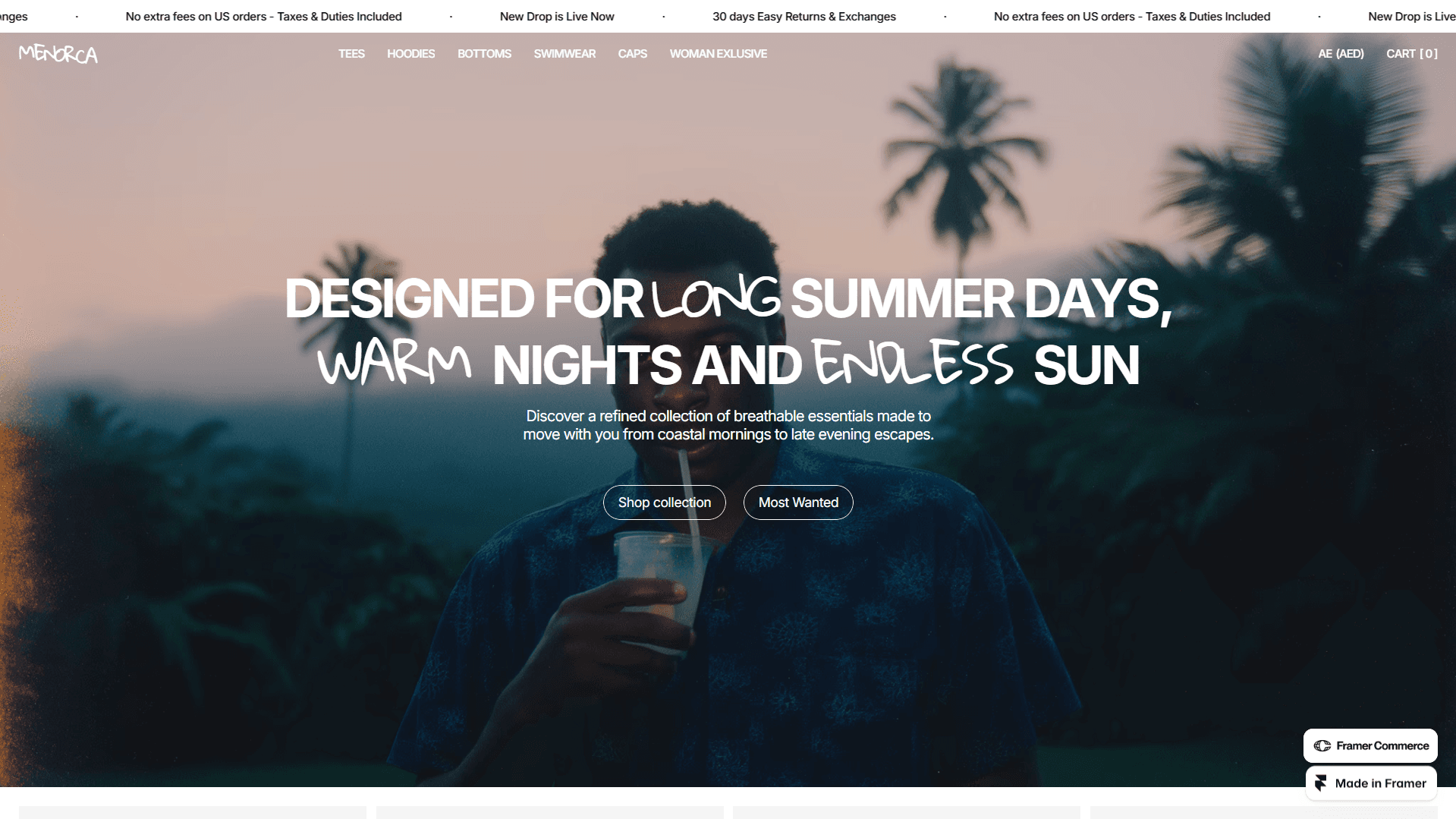
Best for: lifestyle and streetwear brands, drop-based collections, founder-led apparel labels with a clear sense of place.
Why it works: Menorca is built like an actual store, not a demo. The category navigation (Tees, Hoodies, Bottoms, Swimwear, Caps, Women Exclusive) is real. Product cards swap between flat product shots and on-model imagery on hover. Collections are organized into named drops ("Most Wanted," "Chapter 1," "Essentials," "Summer 26"). The marquee announcement bar at the top handles the standard ecommerce trust messaging — returns, taxes, new drop — without feeling tacked on.
Key strengths:
Dual product imagery (flat + lifestyle) on cards
Real category and collection structure, not placeholder pages
Strong editorial photography sets the tone
Discount popup and announcement bar built in
Things to consider: the aesthetic is intentionally warm, sun-drenched, and lifestyle-leaning. If your brand is colder, more clinical, or more luxury-formal, Menorca will need rethinking — it's optimized for a specific energy and leans into it.
2. Vaer
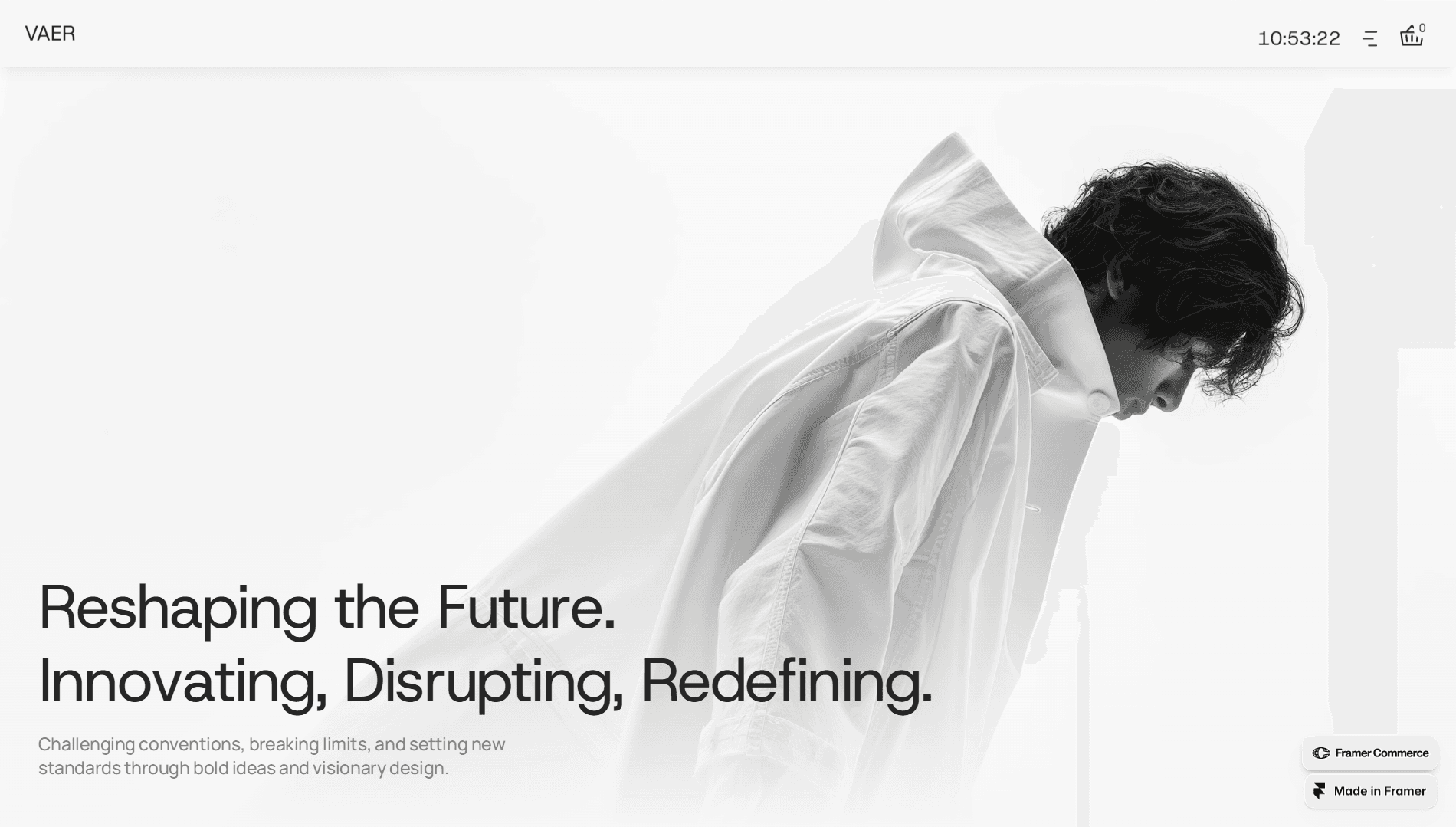
Best for: premium and avant-garde fashion, drop-driven brands, labels that release in chapters rather than seasons.
Why it works: Vaer is structured around drops — Genesis (Drop 001), Evolve (Drop 002), Momentum (Drop 003) — rather than around categories. That structural choice changes the entire feel: each drop has its own identity within the same template, and the product cards are sized and spaced to feel curated rather than catalog-like. The manifesto-style copy blocks between drops give the homepage a magazine cadence.
Key strengths:
Drop-based product organization that suits limited releases
High-contrast, sculptural product photography treatment
Editorial pacing — copy and imagery alternate cleanly
Clear product detail pages from the cards
Things to consider: Vaer is the most aesthetically committed template in this list. That's a strength for the right brand and a constraint for everyone else. If your products are friendly, mass-market, or playful, the avant-garde register here will work against you. Best fit: small luxury labels, designer-led drops, or brands with strong art direction already in place.
3. Axiom
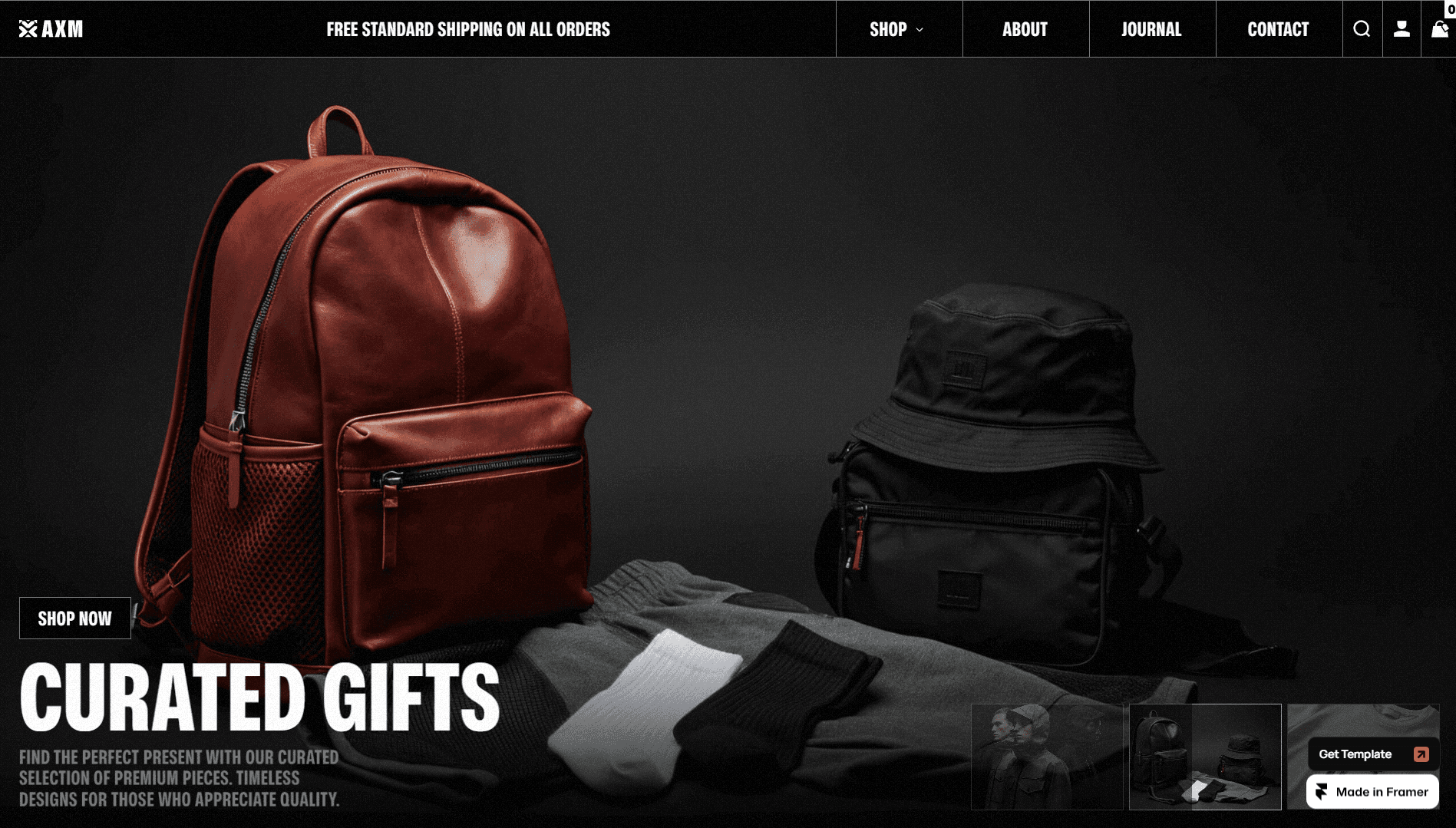
Best for: mid-to-large catalog apparel brands, technical wear, performance and lifestyle clothing labels with real category depth.
Why it works: Axiom has the most complete ecommerce information architecture of any template in this list. The mega-menu opens into categories (Tops, Bottoms, Outerwear, Accessories), tagged sections (New Arrivals, Best Sellers, Sale), and named collections (Elements, Motion, Freedom, Essentials), plus featured promotional cards inside the dropdown itself. Product cards carry status tags (New, Best Seller, Sale) and use dual imagery. There's a journal section, an editorial about page, and a full set of support pages — payment methods, returns, shipping, terms, privacy — that most templates skip.
Key strengths:
The deepest navigation system in the list
Status tags and dual imagery on product cards
Connected to Shopify
Full support and policy page coverage out of the box
Restrained, architectural visual direction
Things to consider: all of that structure is overkill if you're launching with three SKUs. Axiom rewards brands that have inventory depth and are ready to fill a real catalog. If you're not, you'll spend time hiding sections you don't yet have content for.
4. Batavia
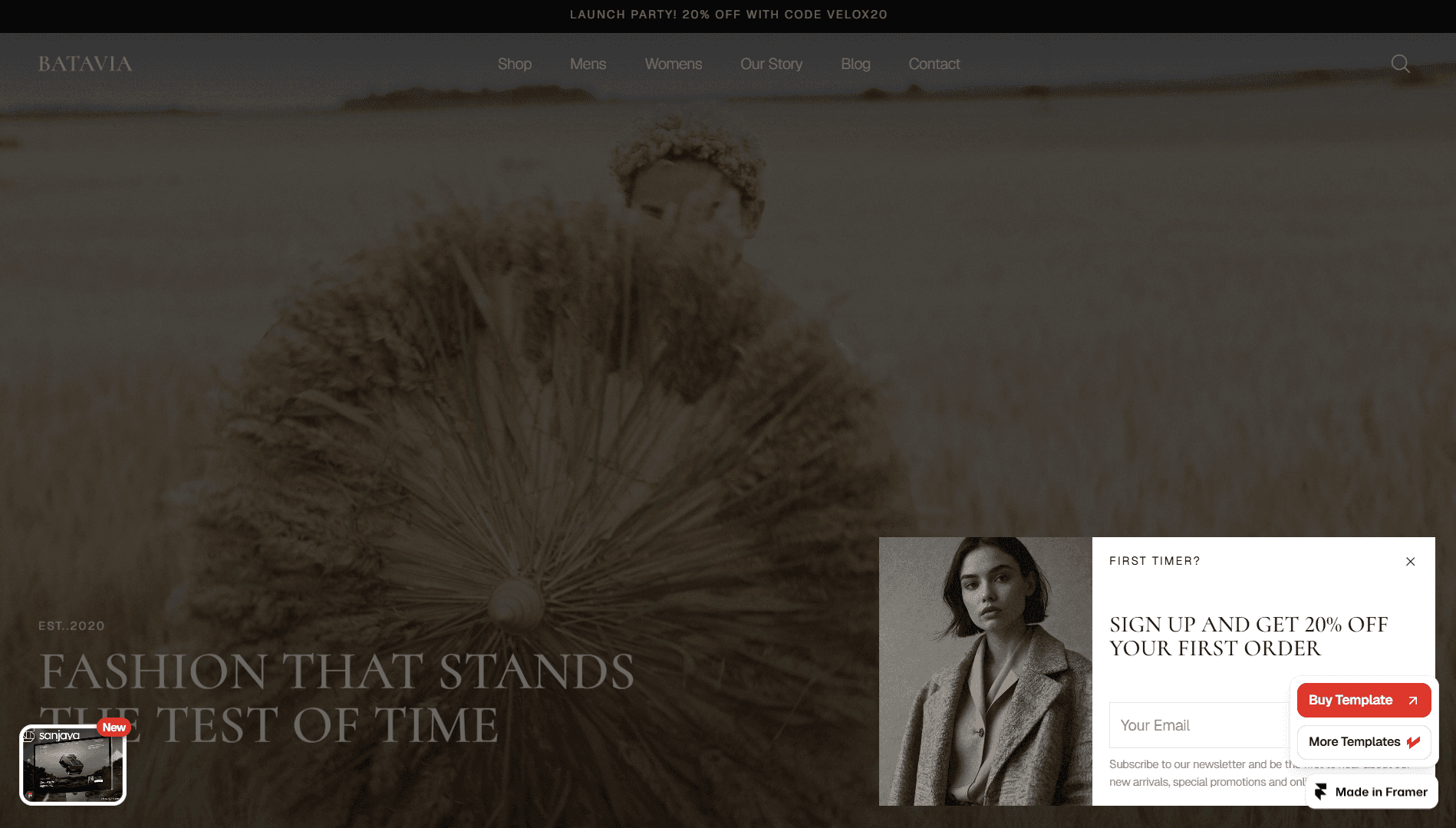
Best for: small-to-mid fashion brands that want a polished, conversion-leaning store quickly.
Why it works: Batavia is the most conversion-aware template in this group. Strikethrough pricing on cards, a featured product block with bullet points (Safe Payment, Free Shipping, Delivery in 2-5 days), a long testimonials carousel, an FAQ section, and a trust-badge block (Free Shipping / Secure Checkout / Money Back Guarantee) are all there. It also splits cleanly into Mens and Womens, has a Lux Blazer / One Piece / Essentials collection structure, and includes a blog.
Key strengths:
Strikethrough pricing and discount logic on cards
Trust badges, FAQ, and testimonials built into the homepage
Mens / Womens split out of the box
Newsletter discount block in the footer
Things to consider: some of the demo content (testimonials especially) reads as filler, and the visual identity is closer to "polished generic" than to anything as opinionated as Vaer or Garm. That's not a flaw if you plan to bring strong photography and your own brand voice — but the template won't carry the brand for you.
5. Garm
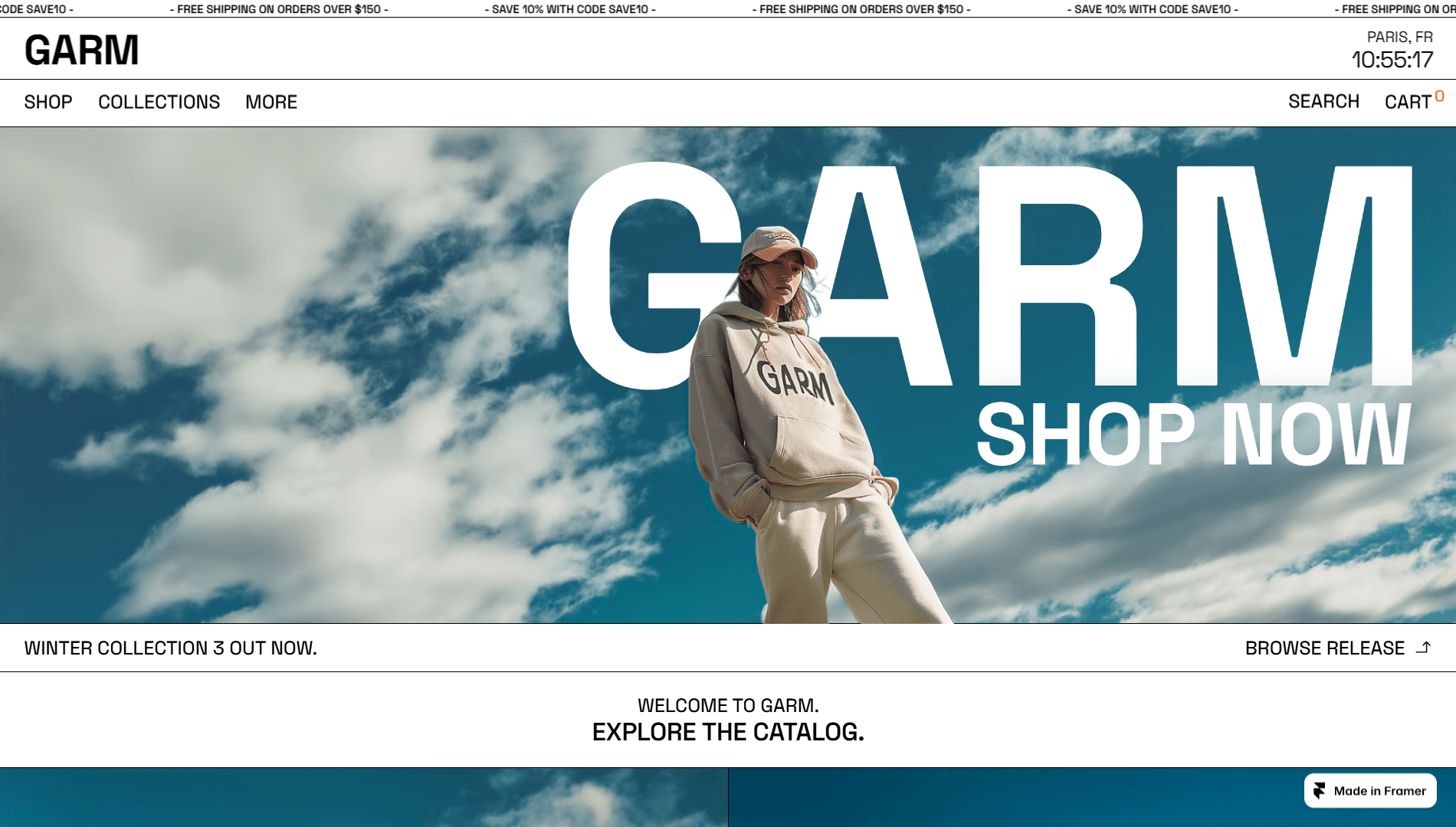
Best for: streetwear and drop-based brands that want a bold visual identity from the moment the page loads.
Why it works: Garm has the most distinctive visual identity in this list. Oversized typography, brutalist-leaning composition, full-bleed lookbook imagery, and confident hierarchy throughout. The navigation is seriously deep — Mens splits into Pants, Outerwear, Shirts, Sales; Womens into Pants, Knitwear, Shirts, Sales; Accessories into Hats, Bags. Collections are named and lookbook-driven (Winter 2025, Essentials, Classics). The collections photoshoot carousel is a nice editorial touch.
Key strengths:
Genuinely opinionated typography and layout system
Deep Mens/Womens/Accessories sub-category structure
Lookbook carousel for collections
FAQ, refunds, contact, and legal pages organized cleanly
Things to consider: the strong identity is the whole point and the whole risk. If your brand is soft, feminine, or warm, Garm will fight you. It's designed for confident streetwear energy and works best when you lean into that, not against it.
How to choose the right Framer ecommerce template
Most "best ecommerce template" decisions go wrong because people pick on aesthetic alone. A few practical filters:
By number of products. If you're launching with under ten SKUs, a deep-catalog template like Axiom or Garm will leave you with empty sections to hide. Vaer's drop structure or Menorca's collection model handles small catalogs more gracefully. Above forty or fifty SKUs, the opposite — Axiom and Garm start to look right because their navigation can carry the weight.
By brand maturity. If you have strong photography, a defined art direction, and a clear voice, an opinionated template (Vaer, Garm) will amplify what you already have. If your brand is still forming, a more neutral template (Commerce, Batavia) gives you room to shape it without the template fighting you.
By product type. Lifestyle and apparel brands have the most to choose from in this list. For premium or luxury, Vaer fits cleanest. For drop culture, Vaer or Garm. For technical or performance wear, Axiom. For everyday lifestyle apparel, Menorca or Batavia. For mixed digital and physical, Commerce.
By launch speed. If you need to be live in a week, prioritize templates whose default state already looks close to your brand — fewer overrides means fewer hours. Templates with fewer pages and lighter structure (Commerce, Vaer, Menorca) launch faster than templates with full navigation systems and policy pages (Axiom, Garm).
By what you'll actually customize. Be honest about how much design work you're willing to do post-purchase. The "perfect" template is the one whose defaults you're happy to live with, not the one with the most flexibility you'll never use.
Final thoughts
The strongest argument for Framer in 2026 is that you no longer have to choose between design quality and ecommerce capability. All six templates here ship with real product structure, real navigation, and real conversion patterns — and most of them are genuinely good-looking out of the box.
The decision isn't which template is best in the abstract. It's which template fits your product, your catalog size, and the brand you're trying to build. If you're after a flexible base, Commerce. If you want strong identity and lifestyle warmth, Menorca. For drop-based premium fashion, Vaer. For deep catalog apparel, Axiom. For conversion-leaning polish, Batavia. For streetwear with a bold visual register, Garm.
If you'd like to look more closely at the two I built — Menorca and Vaer — the previews will tell you more in two minutes than any list ever could.
FAQ
Are Framer ecommerce templates good for real online stores? Yes — most strong Framer ecommerce templates connect to Shopify for inventory, checkout, and payments, while Framer handles the storefront design and CMS. You're not running a fake checkout; you're getting a Shopify backend with a much more design-forward storefront.
Which is the best Framer ecommerce template for a small brand? For small brands with under ten products, Vaer (drop-based) and Menorca (collection-based) handle small catalogs without leaving empty sections. Commerce is also a solid neutral option for MVP stores.
Can I use a Framer ecommerce template without Shopify? It depends on the template. Some are built around Shopify's product CMS, while others use Framer's built-in CMS for static product pages. Always check the template description — if you don't plan to use Shopify, look for templates that don't rely on it.
Are Framer ecommerce templates mobile responsive? The templates in this list all appear responsive in their previews, but mobile quality varies between templates. Always preview on a phone before buying — the desktop demo isn't the full picture.
How customizable are Framer ecommerce templates? Very. Framer's component and override system means you can change colors, typography, sections, and layouts without touching code. The practical limit is usually time, not capability.
What's the best Framer template for a fashion ecommerce store? For fashion specifically, the strongest options in this list are Menorca (lifestyle/streetwear), Vaer (premium/avant-garde), Axiom (technical/performance), Batavia (classic fashion), and Garm (bold streetwear). Pick by brand voice, not by feature count.